
If you are married to a U.S. citizen, your case is usually in one of the faster family categories. You are not stuck in the long visa line that many other families face. Still, the wait can feel heavy when work, travel, and daily life are on hold.
The answer depends on one question. Is the foreign spouse already in the United States and allowed to file here, or will the case go through a U.S. consulate abroad? That choice changes the steps and the waiting points.
In many current cases, a spouse who applies from inside the United States through adjustment of status can expect the full case to take about 10 to 20 months. A spouse who applies from outside the United States through consular processing often sees a total timeline closer to 15 to 25 months.
That range is wide for a reason. Some couples move fast because they file a strong package the first time and answer every notice quickly. Others lose months because of missing papers, income issues, weak marriage proof, or long embassy interview waits.
The Two Paths That Decide The Clock
There are two common paths for a U.S. citizen filing for a spouse. The first path is adjustment of status. This is for a spouse who is already in the United States and can apply for permanent residence from inside the country. In many marriage cases, the U.S. citizen files Form I-130, and the spouse files Form I-485 at the same time.
The second path is consular processing. This is for a spouse who is outside the United States, or for a spouse who will finish the case through a U.S. embassy or consulate abroad. In that path, the case starts with Form I-130, moves to the National Visa Center, and then ends with an interview overseas.
A Real Timeline If Your Spouse Is Already In The United States
First comes filing. If the case is put together well, receipt notices often arrive within a few weeks. After that, the spouse is usually called for biometrics. That step often happens in about one to two months, though timing can shift by location.
Then comes the long middle part. USCIS reviews the marriage proof, background checks, medical exam, and financial support papers. If the couple also filed for work permission, that benefit may arrive before the green card decision, but not always quickly.
For many straightforward marriage cases filed inside the country, a full timeline of about 10 to 20 months is common right now. Faster approvals do happen, but they are not the norm.
A Real Timeline If Your Spouse Is Outside The United States
If your spouse is abroad, the case usually starts with a Form I-130 filed by the U.S. citizen. This first stage often takes the biggest chunk of time. In many current cases, this part alone can take about 12 to 18 months.
After approval, the case moves to the National Visa Center. The federal handoff itself may not be the slowest piece. Right now, the National Visa Center says it is creating new cases about two to three weeks after receiving them from USCIS and reviewing submitted documents in under a week.
The part that often adds more time is gathering civil papers, getting the financial forms right, fixing mistakes, and waiting until the file is marked complete.
After that comes the interview wait at the U.S. embassy or consulate. This is where timelines can change a lot from one country to another. Some posts are moving immediate relative cases almost in real time. Others are working through documentarily complete cases from many months back.
Once the interview is done, some people get a visa quickly. Others go into extra review, which adds more waiting. After the spouse enters the United States on an immigrant visa and pays the required immigrant fee, the physical green card usually arrives by mail later. A full consular case for a U.S. citizen’s spouse often takes around 15 to 25 months when things go normally, but embassy backlogs can push that higher.
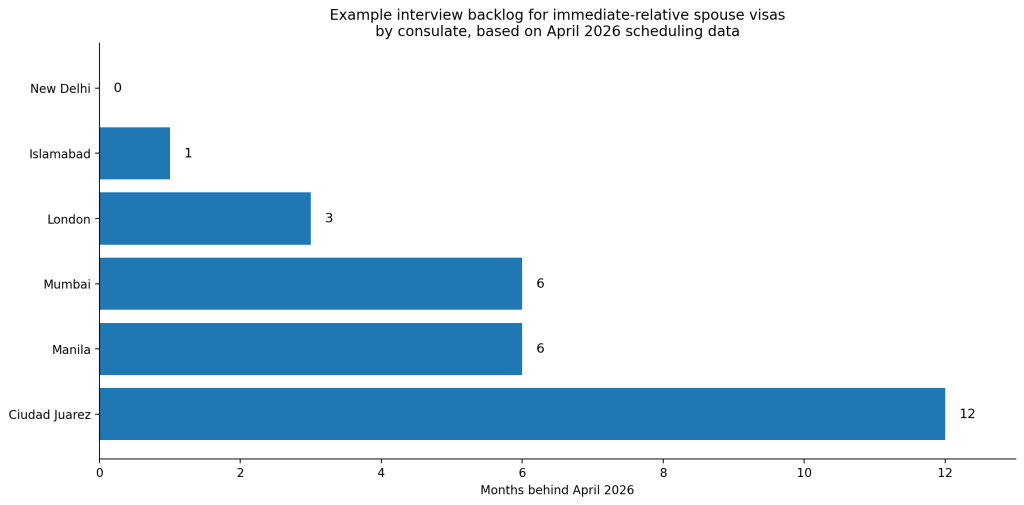
That is why two couples with very similar cases can finish on very different dates. The embassy or consulate handling the interview can change the final stretch by months.
Why Do Some Cases Move Faster Than Others
Many cases slow down because the first filing was weak. A missing birth record, the wrong fee, an outdated form edition, or an incomplete medical exam can all cost time. So, there can be weak proof that the marriage is real. If a couple sends only the marriage certificate and a few photos, that may not tell enough of the story.
Money issues also matter. If the U.S. citizen sponsor does not meet the income requirement and the case needs a joint sponsor, the case can stall while new paperwork is collected. Past immigration problems can create even bigger delays. Prior overstays, fraud concerns, arrests, or waiver issues can add months.
How To Keep The Case Moving
The best way to save time is to file a clean package the first time. Make sure names, dates, addresses, and travel history match across every form. Send strong marriage proof early, not after a government request.
Double check the financial support form before filing. If a joint sponsor is needed, solve that before filing rather than later. Also, watch every notice closely. Missed biometrics, late responses, or an old mailing address can turn a normal case into a long one.
Can My Spouse Stay In The United States While The Green Card Case Is Pending?
Often, yes, if the case is being filed through adjustment of status and the spouse is allowed to stay under that filing path. But the answer depends on how the spouse entered the country, whether the filing was done correctly, and whether there are past immigration problems. A mistake here can create serious trouble, so it is worth checking the facts before filing.
Can My Spouse Work While Waiting For The Green Card?
Not right away in every case. A spouse filing inside the United States often applies for work permission during the case, then waits for that card to be approved. A spouse going through consular processing abroad usually waits until entering the United States with the immigrant visa before starting work here.
Will Having Children Together Make The Case Move Faster?
Children can help show that the marriage is real, but they do not usually speed up the case by themselves. Officers still look at the full picture, including shared records, living arrangements, finances, travel history, and the overall consistency of the file. Strong proof matters more than a single item.
What Happens If The Government Asks For More Evidence?
A request for more evidence does not always mean the case will be denied, but it usually means more waiting. The case can slow down while you gather missing papers or fix weak parts of the filing. The safer move is to answer fully, stay organized, and avoid rushing out a partial response.
Should We Speak With A Lawyer Before Filing A Marriage Green Card Case?
For many couples, that is a smart step, especially if there are income issues, prior visa overstays, arrests, past petitions, or any worry about how the case will be viewed. Early legal help can catch problems before they turn into delays. It can also help you build a stronger file from day one.
For most couples, the real wait is not one fixed number. It is a range. If your spouse is filing inside the United States, think in terms of about 10 to 20 months in many current cases. If your spouse is applying from abroad, think in the range of about 15 to 25 months, with the local embassy or consulate playing a huge role in the final stretch.
The smartest move is to protect your timeline from avoidable mistakes. File carefully. Send strong proof. Fix income issues before they become case issues. Answer notices fast. A well-built case will still take time, but it has a much better shot at moving without avoidable delays.
If you want clear guidance before you file, Hong Immigration Law can help with marriage green card cases, including adjustment of status and consular processing.
Schedule a consultation call to review your timeline, spot risks early, and build a stronger case from the start. Call 612-217-0838 to get started.